The Yet
His shirt is soaked through and stuck to his back. There's a gash on his shin that he hasn't looked at since try four. His hands are on his knees, board upside down between his feet, wheels still spinning. Try eleven just ended in the tree again: clean grind, clean flip, oak tree. He's staring at the nine stairs like they owe him something.
Thirty seconds from now he'll push off again. But right now he's just a body doing math it doesn't know it's doing.
I. The Apparatus
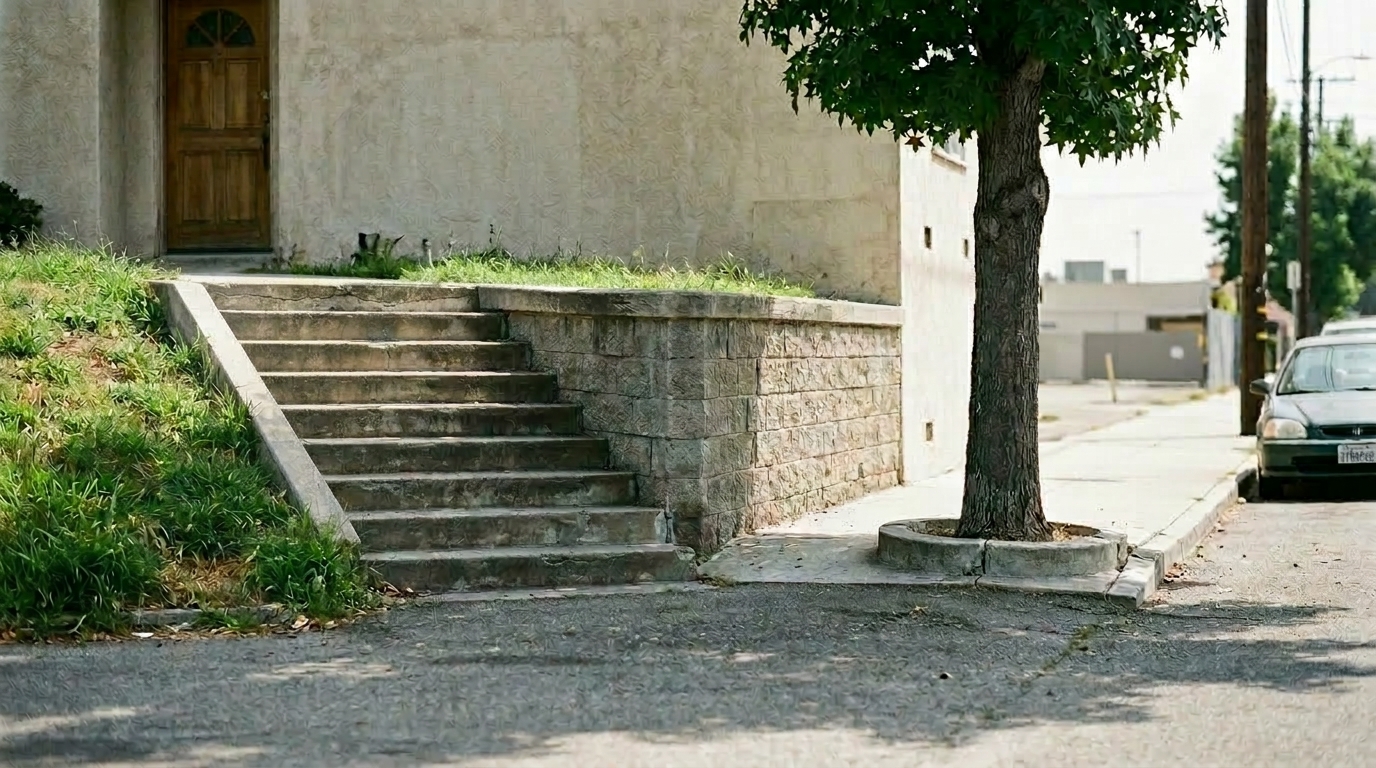
The spot is residential. Nine stair set with a retaining wall running along the top. Chest-high, rough concrete, the kind of thing that holds back someone's yard from the sidewalk below. The wall runs the length of the stairs and then ends, and where it ends there's a gap between the wall's edge and the ground. Three, maybe four feet of nothing. Then a strip of sidewalk. Then a live street.
There's a tree. It grows right there at the end of the wall, trunk in the gap where you'd land. Roots buckling the sidewalk around it. It's been there longer than anyone on this street.
There is no run-up. You get maybe fifteen feet of flat ground at the top before you're on the wall. The sidewalk at the bottom is narrow enough that making the trick means rolling into traffic unless you shut down hard.
This is the spot. Nobody designed it. Nobody would.
The trick: push in along the flat at the top, lock into a 50-50 grind on the wall, ride the length of it, the stairs dropping away beneath you, tre flip off the end over the gap, clear the tree, land on the sidewalk, and stop before the street kills you.
Eight of us are here. One is skating. The other seven showed up to make it possible.
No league organized this. No permit was filed. No one was paid or asked. Someone sent a text with a pin drop and seven people showed up with a camera, a safety vest, and nowhere else they'd rather be on a Saturday. None of it (not the spot, not the crew, not the apparatus) was organized by anything except the desire to be there when it happened.
Someone brought the vest, an actual high-visibility vest, the kind road crews wear. He's standing in the street with his arms out, stopping cars. He's been doing this for forty-five minutes. The cars are not happy. He doesn't care. When a driver honks, he holds up one finger, one more, one more, and turns back to the stairs.
Someone else has the camera. Fish-eye, low angle, positioned at the bottom of the stairs where the gap is biggest. He hasn't moved. He's shot eleven tries and he'll shoot eleven more if that's what it takes. The footage of the misses matters too. You need them for the edit, the sequence that shows what the make cost.
Two guys are sitting on the wall at the top, legs dangling. They're not doing anything visible. They're doing something essential. When he walks back up after a bail, they're the ones saying you had it, the flip was clean, just stay over it. Between tries they're quiet. They know when to talk and when to shut up. They've been here before, on both sides of it.
One guy is spotting, watching the sidewalk for pedestrians, calling out when someone's coming through. Another is sitting on the curb across the street, holding boards, keeping water bottles cold in a plastic bag. The last one is just standing there. Watching. Flinching on every try like his own body is on the wall.
That's me. I'm the one flinching.
I was clinching my buttcheeks each try like I was the one on the wall. Every time he locked into the grind my whole body went rigid. When he'd bail (foot slipping off the wall, board shooting into the street, body hitting concrete) I'd exhale like I'd been holding my breath underwater. Because I had been.
This is what people don't see when they see a skate clip. The fifteen-second video is one person doing one trick. The reality is eight people, forty-five minutes, a safety vest, a fish-eye lens, two guys who know when to shut up, and a stranger's retaining wall.
II. The Tree Doesn't Move
Try one was a feel-out. He rode the wall without the tre flip, just grinding the length of it and hopping off before the gap. Calibrating speed, feeling where the concrete gets rough, checking the distance to the tree. He came back up nodding. Yeah. Yeah, that's doable.
Try two he went for it. Locked the 50-50, popped the tre flip at the bottom, and the board spun clean but his feet weren't under it. He landed on the sidewalk running, board shooting into the street. Vest Guy stopped a Honda. Nobody blinked.
Try three he got closer. Grind was clean, flip was almost there, he caught it but landed with too much weight on his heels. His back hit the stairs. He sat there for a second. Got up. Walked back.
Try four is when the shin opened up. His board hung up on a rough patch in the wall. Loss of speed, awkward dismount, shin against concrete. Blood. He looked at it, wiped it with his shirt, and walked back up the stairs. No one suggested stopping. That's not what any of us were here for.
By try six the neighbors came out. A woman on the porch of the house whose retaining wall this was, coffee mug in one hand, screen door held open with her hip. Not angry. Watching. A guy walking a dog stopped on the sidewalk across the street, the dog circling his legs, wrapping the leash around his knees. Two kids on bikes appeared from somewhere, straddling their seats, silent.
They didn't know what a tre flip was. They didn't know what a 50-50 was. Didn't matter. The stairset was nine stairs; they could count. The wall was long and the gap at the end was real; they could see. The tree was in the way; they could tell. And every time he walked back up those stairs, they understood something without vocabulary: he's going again.
The tree is in the gap. It will not move. There's no variance, no official to appeal to, no ruling that adjusts the parameters. You clear the tree or you don't land. The difficulty doesn't need to be explained when it's physical and present. A wall, nine stairs dropping away beneath it, a gap, a tree, a street. Anyone standing on that sidewalk could feel the math.
Try eight: clean grind. Clean flip. The board rotated perfectly, he caught it, both feet, and the nose hit a root buckling out of the sidewalk at the base of the tree. He went down hard on his hip. The woman on the porch put her hand over her mouth.
Try nine: the best one yet that wasn't a make. He had everything. Grind was locked, speed was right, the tre flip was clean and caught, he was over it. And his back foot slipped on the landing. He rolled off the side of the board and stumbled into the street. Vest Guy caught him by the arm.
The walk back after nine was different. Not slower exactly. Heavier. He picked up his board by the nose and carried it with one arm hanging, the other wiping his face with the bottom of his shirt. Halfway up the stairs he stopped and stood there, looking at the ground, and you could see him deciding something. Not whether to try again. That was settled. Whether to be angry or patient. He chose patience. He finished the walk, set his board down at the top, and rolled his neck. The two guys on the wall said nothing. They didn't need to. The walk back told them everything: he's not done.
After nine the dog-walker sat down on the curb. He wasn't going anywhere.
Try ten: sketchy grind, didn't commit to the flip. He knew it before he popped. Stepped off. Walked back. Didn't need to be told.
Here's what the strangers had seen by now, whether they knew the words or not: the grind could be clean. The flip could be clean. The catch could be clean. The landing could be clean. Every component had succeeded at least once. Just never all at the same time.
Yet.
That word, yet, was in every body on that street. The crew knew it because they'd seen the pieces. The strangers knew it because they'd watched the arc. The woman on the porch knew it because she'd stopped going inside. Eleven tries in, nobody was leaving.
III. The Last Run-In
Try eleven went into the tree. Clean grind, clean flip, clean catch. And the tree. His shoulder clipped a low branch as he came through the gap and it spun him sideways. He landed on his feet somehow, stumbling, and punched the trunk. Not hard. Not angry exactly. The way you'd push something that was simply in your way and wouldn't move.
He walked back up the stairs slower this time. The shin had opened up more. His shirt was a different color than it started. The two guys on the wall didn't say anything. One of them handed him a water bottle. He drank the whole thing.
He wouldn't let himself stop and we wouldn't let him stop. Same sentence. Not because we were cruel. Because we'd all been here before. On both sides of it. The trick was in there. The evidence was in the footage: eleven tries, every component clean at least once. The make was assembled across those tries like a sentence you keep rearranging until the words are in order.
What I remember most is the thirty seconds before the last try. He was standing at the top of the run-in. Board under one foot, other foot on the ground. He wasn't looking at the stairs. He was looking at nothing. Somewhere past the street, past the houses, somewhere the rest of us couldn't see. His breathing changed. I watched his shoulders drop. Not relaxation. Something past relaxation. Something his body had figured out that his mind was still catching up to.
The two guys on the wall went quiet. The filmer adjusted the lens. Vest Guy stepped further into the street. The kid on the bike leaned forward on his handlebars. I stopped breathing.
He pushed three times and dropped onto the wall.
The grind was immediate and clean. Locked, no wobble, speed right. He rode the wall the full length of it, the stairs dropping away beneath him, and I could hear the grinding from forty feet away, this long unbroken scrape of metal on concrete. At the end he popped.
The board flipped. Tre flip, the board spinning and flipping at once beneath him. And for a half-second nobody on that street was standing on the ground. All of us were in the air with that board. Every buttcheek on the block clenched now.
He caught it. Both feet. Through the gap, past the tree, past the tree, and his wheels hit the sidewalk clean.
The sound a skateboard makes when four urethane wheels hit concrete after a drop. It's a specific sound. A hard, flat crack that isn't quite a slap and isn't quite a pop. It's the period at the end of a sentence.
Then nothing. A half-second where the trick had happened and nobody had caught up to it yet. The board was rolling. He was on it. The tree was behind him. And the street was perfectly, impossibly silent. The way a room goes silent when something has changed and the air hasn't figured it out yet.
Then the street exploded.
The crew, all seven of us, converged on him. Screaming. Actual screaming, the kind that comes from your stomach. Hugging. Someone grabbed his head with both hands. Someone was jumping. I was jumping. The two quiet guys on the wall weren't quiet anymore. The filmer still had the camera up, muscle memory, getting the celebration, which is part of the footage because the landing isn't the end, the reaction is.
The woman on the porch was clapping. The dog-walker was clapping. The kids on the bikes were yelling. Somebody in a car that Vest Guy was still blocking honked, and it sounded like cheering.
He was standing in the middle of it. Soaked, bleeding, grinning so hard it looked painful. His eyes were wet. Not crying.
And then there's the stranger.
She was standing on the sidewalk across the street. She'd stopped maybe around try seven or eight. I hadn't noticed exactly when. She had her phone out. She'd been filming. Not the whole time, but enough. The landing, the silence, the screaming, the pile of bodies, the woman clapping on her porch.
She was smiling. The way you do when you've seen something and you're not sure what it was but you know it was real.
She probably showed that video to someone later that night. You have to see this, these kids were doing skateboard tricks on some stairs and they all went crazy when the guy landed it. And the person watching would see a shaky phone clip of some dude on a board and a bunch of people yelling and they'd say oh cool and swipe to the next thing.
She got the ending. She didn't get the why.
But she stayed. She didn't have to. She could have walked past on try seven and kept going. But something in the visible difficulty, the obvious stakes, the arc of attempts. Something held her there. She calibrated without knowing it.
She felt the yet.
(b)hole is free to read, always. Support the work if you can.