1. Running Backwards
The filmer is running backwards. This is the first thing to understand.
A skater approaches a twelve-stair handrail at full tilt. The filmer is already ahead of him, fisheye lens two feet from the ground, sprinting backwards down concrete steps while holding a twenty-pound camera steady. If the skater falls, the skater eats shit. If the filmer falls, the filmer eats shit and ruins the footage and probably destroys a camera worth more than his car.
Nobody talks about this. Every skate clip you've ever watched; every kickflip, every rail slide, every twelve-second Instagram story required a second person running backwards through the same terrain. The skater's name goes on the trick. The filmer's name goes in the credits, if there are credits, which increasingly there aren't.
The filmer is the most important invisible person in skating. And the job is changing.
3. Spike Jonze Ruined Everything /s
Before Being John Malkovich, before Her, Spike Jonze was a kid who hung around skate shops and started filming.
Video Days came out in 1991, for Blind Skateboards. It is widely considered the most influential skate video ever made, and the reason has nothing to do with the tricks. What Jonze did was treat each skater like a character. He chose Jackson 5 for Guy Mariano's part: a joyful, innocent song for a joyful, innocent skater. He added skits. He added personality. Before Video Days, a skate video was a document: here are tricks, set to music. After Video Days, a skate video was a film: here are people, and what they do on a skateboard tells you who they are.
Then Yeah Right! in 2003. For the invisible board sequence, Jonze had skaters ride green-screen boards that were edited out in post, making it look like they were floating on air. For the Owen Wilson cameo, Wilson talks trash about his own skating, then approaches a handrail and stomps a bluntside. It looks real. It's not. During a quick camera pivot, Eric Koston in a blond wig takes Wilson's place. The landing is deliberately ugly, too clean and nobody would believe it.
Jonze proved something that mattered: a skate filmer could become an auteur. The person holding the camera wasn't documenting skating. They were making art that contained skating. The trick was the material. The film was the work.
4. The Four-Year War
If Jonze proved skate videos could be art, Ty Evans turned them into an arms race.
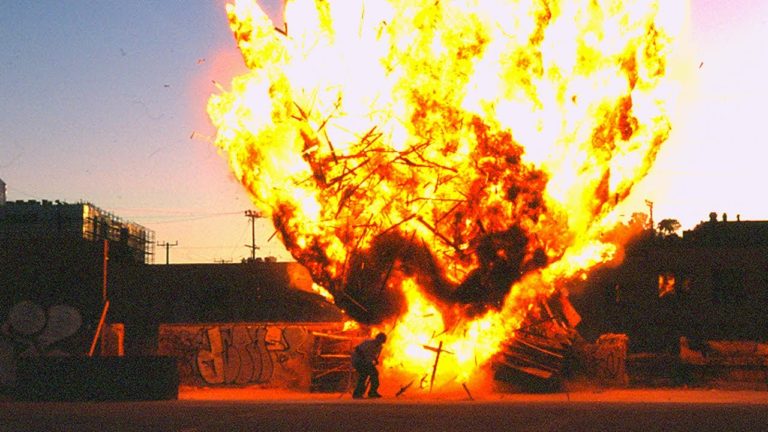
Evans introduced RED cameras, crane shots, and Hollywood-grade production to skating. For Lakai's Fully Flared in 2007, he and Jonze opened the video with a slow-motion tracking shot of skaters navigating a course rigged with napalm explosions, set to M83. The film premiered at Grauman's Chinese Theatre in Hollywood.
Fully Flared took four years to make. Nineteen skaters. Multiple filmers. The production values were unprecedented. And it nearly destroyed the team.
"Guys weren't talking to each other," Evans said in an interview. "This guy won't skate with this guy. It sucked."
The pressure to produce "their best video part ever" killed the fun. Mike Carroll, who had co-founded Girl Skateboards specifically to escape this kind of corporate intensity, looked around during production and realized he was right back in the same situation. How did this happen? He'd built the thing he was running from.
Evans tried to insert a comedic skit: a "floating camera" suspended from a pole on fishing wire. With only four weeks left to film, the stressed-out skaters balked. "What the fuck are we doing here?"
The skit got cut. The video came out. It's a masterpiece.
But Evans himself admitted: "Looking back on Fully Flared... you can tell a lot of these guys put in everything they had, but when that happens, you lose the fun aspect of skating."
The filmer's paradox: push the craft higher and the experience gets worse. Make the film better and the skating gets more miserable. The relationship between filmer and skater, which started as two friends with a camera and a board, had become something closer to director and actor. And skaters, people who picked up a board specifically because nobody could tell them what to do, started to resent the lens.
Not openly. Not in interviews. But you could feel it in the shift that came after. The next generation of important skate videos didn't go bigger. They went smaller. The arms race ended not because someone won, but because the skaters walked off the set.
5. The Poet of the Zoom
William Strobeck solved the paradox by ignoring it entirely.
Where Evans built toward spectacle, Strobeck stripped everything back. His Supreme videos (cherry (2014), BLESSED (2018), Play Dead (2022)) are shot with the intimacy of a home movie and the eye of someone who studied the Maysles brothers. He zooms into faces. He holds the camera on a skater's grimace after a brutal bail for fifteen seconds longer than feels comfortable. He films the blood trickling above a waistband of Supreme boxer-briefs, the altercation with an angry pedestrian, Jason Dill furiously slapping himself.
In BLESSED, a skater tries to off-road down a dangerous dirt hill and lands hard on his tailbone. Strobeck doesn't cut. The camera stays fixed on the pained reaction for over fifteen seconds. It works the way a Chantal Akerman hold works: the refusal to look away becomes the statement.
The filmer's power isn't the trick. It's the moment after the trick. The moment the skater's face decides whether to try again.
But Strobeck also showed the risk of the auteur model. In Play Dead, Tyshawn Jones, one of the most talented skaters alive, launched a massive kickflip over subway tracks. It was one of the most anticipated tricks of the year. Strobeck was so zoomed in that he cut off Jones's entire body. Only his feet were in the frame.
The filmer's vision ate the skater's trick. The audience saw feet. The trick happened somewhere above the camera's gaze. The internet lost its mind.
The tension has always lived inside the filmer's role: whose edit is it? The skater who landed it, or the filmmaker who chose how to show it?
6. The Shadow in the Frame
In 2008, a filmer named Buster O'Shea shot a video called A Happy Medium in Phoenix, Arizona. It was too hot to skate during the day, so they filmed at night, under artificial lights. The lights threw the cameraman's shadow into every shot.
In most contexts, this would be a mistake. You'd reshoot. You'd adjust the angle. O'Shea left it in. The filmer's shadow became a recurring presence alongside the skater — a second figure, always there, darkening the same concrete.
The filmer has always been in the frame, even when you can't see them. Every angle is a choice. Every cut says: this moment, not that one. The filmer decides what you see, and in doing so, decides what skating looks like to the world.
Jacob Harris, who creates the "Atlantic Drift" series, takes this even further. Inspired by Chris Marker and Patrick Keiller, Harris deliberately makes his footage feel like degraded memory, "fragmentary, flawed and hallucinatory." He wants the viewer to experience a skate video like a half-rotting recollection of their own, something that might have happened to them in a dream.
A long way from a camera strapped to a bicycle in 1965. But the impulse is the same: make the medium visible, insist that how something is filmed is part of what it means. Black and Harris are sixty years apart, doing the same work. The surface still matters.
7. A Thousand Cameras
The barrier to entry erodes.
The shift happened gradually, then all at once. By the mid-2010s, every skater had a 4K camera in their pocket. You could prop your phone against a curb, land the trick, pick up the phone, edit it in an app, and post it in eleven minutes.
A veteran filmer writing for Bigfoot Magazine captured the existential crisis: "What is the point of a self-proclaimed skateboard filmer these days? And what separates them from your average person with a smartphone?"
That question assumes the answer is bad. It doesn't have to be.
For decades, the filmer was a gatekeeper; a benevolent one, usually, but a gatekeeper all the same. If you didn't have a filmer, your trick didn't exist. It didn't make the video. It didn't get seen. The filmer decided who mattered, which meant the filmer decided who didn't. And the people who didn't get filmed were disproportionately the ones who didn't live near the right shops, didn't know the right crews, didn't have access to the small network that turned skating into culture.
In Addis Ababa, a skater named Sosina Challa learned to ride by hanging around parking lots near her high school, watching others skate, borrowing their boards when they'd let her. She learned to build her own decks, wheels, trucks, everything. No filmer was documenting this. No American video distributor was putting Addis Ababa parking lots in a full-length cut. In 2020, Challa posted a flyer on Instagram and Telegram: free skating lessons for girls. That single post created Ethiopian Girl Skaters, now the country's first female skate crew, sixty members and growing. Their clips (phone-filmed, self-produced) reached 82,000 followers, a film at Tribeca, a feature on Olympics.com.
In Lagos, a crew called Wafflesncream built Nigeria's first skate scene entirely through Instagram documentation. Phone clips of skating streets in a city of twenty-one million people with zero skateparks. That visibility eventually produced West Africa's first public skatepark.
Under the old model, these scenes don't exist. Not because the skating wasn't happening, it was, but because nobody with a VX1000 and a distribution deal was there to make it count. The bottleneck wasn't talent. It was proximity to the people who held the cameras.
The full-length skate video used to tell a story; not a plot, but a feeling that accumulated over forty minutes. Song selection was an art form. The filmer chose the music, and the music became inseparable from the skater. Guy Mariano is Jackson 5. Jason Lee is Husker Du. Premieres were events. You packed into a skate shop or a rented theater, and somebody's ender landed, and the room erupted.
That form isn't dead. Strobeck is still making full-lengths. So is Greg Hunt. But it's no longer the only way a trick gets to count. And the question worth asking isn't "what did we lose?" but "who gets to participate now that the bottleneck is gone?"
What the phone produces is different from what a dedicated filmer produces; it's rawer, less composed, stripped of the narrative that forty minutes of sequenced footage can build. A Strobeck video and a phone clip are not the same cultural object. They don't need to be. The phone clip isn't a worse version of the filmer's edit. It's a different form, with its own grammar, and it reaches people the full-length never would have.
8. The Filmer's Choice
Ian Ostrowski films for Genesis and Jenkem. He uses iPhones and handycams. Not because he can't afford better equipment, but because setting up a professional camera means missing the moment. "If I were to take the time to set my real camera up I would've completely missed the moment as it's happening."
Adaptation, not surrender. Ostrowski understood something: the filmer's job was never about the camera. It was about being present. About choosing to record this particular second of this particular friendship on this particular street corner, because it won't happen again.
VX1000 cameras (the Sony that defined the look of 2000s skate videos, the one that made everything feel like a memory of a parking lot at dusk) now sell for over $3,000. They're obsolete technology. You can get cleaner footage from a phone. People buy them because they want to feel something that clean footage doesn't produce.
The nostalgia isn't for the camera. It's for the role. It's for the time when a skater needed someone else, a filmer, running backwards, holding the frame steady, to make the trick exist. When the trick didn't count unless someone chose to point a lens at it and say: I saw this. It happened. Here.
Maybe the role didn't disappear. Maybe it dispersed. Every skater holding a phone for a friend is a filmer now. The craft is different. The intentionality is different. But the act, one person choosing to document another person's attempt at something difficult, that's the same act it always was.
9. Running Backwards (Again)
Skating still has filmers. William Strobeck is still shooting. Greg Hunt is still composing landscapes around skaters the way a cinematographer composes them around actors. Kids with VX1000s they bought for three grand are filming their friends at night, shadows in every frame, exactly the way Buster O'Shea did in Phoenix in 2008.
And now there are a thousand other cameras too. Phones propped against curbs in Lagos and Addis Ababa. Clips that never would have existed under the old model, from skaters who never would have been seen.
I watched a stranger film a skater landing a trick from across the street once. She got the landing, held her phone steady, caught the make and the celebration. She missed the twelve tries before it, the bleeding shin, the seven people who showed up and stayed because they believed this one was going to happen. She felt something (you could see it in the way she held her phone) but she got the ending, not the why.
The filmer always got the why. That was the job, not just the camera or the angle or the song, but the why. The forty-five minutes before the trick. The eleven attempts. The decision to stay.
The dedicated filmer still gets that. They still build the forty-minute feeling. They still choose the song that follows you into the grocery store twenty years later. But the trick no longer needs their permission to exist. And the question of who gets documented, who gets a filmer running backwards for them, has a different answer now than it did in 1991, or 2003, or 2007.
The answer is: anyone with a friend and a phone.
That's not the end of the filmer's edit. It's the edit getting wider.
Sources: Film Comment ("Street Level," Ian F. Blair, 2026); Bigfoot Magazine ("Filmer's Lament"); Dazed ("William Strobeck" profile); Skin Phillips interviews with Ty Evans; Free Skate Magazine (Jacob Harris / "Atlantic Drift" profile); LVL3 (Ian Ostrowski interview); Global Voices, Dazed MENA (Ethiopian Girl Skaters); Huck, It's Nice That (Wafflesncream / Lagos); Wikipedia (Fully Flared, Video Days, Skaterdater). Research compiled via NotebookLM.
(b)hole is free to read, always. Support the work if you can.