Terminal Velocity
1. The Bricks
The bricks were red, Italian-style, inspired by Siena's Piazza del Campo. Lawrence Halprin and Mario Ciampi laid them in 1971, imagining an open plaza where San Francisco met the Bay. They did not imagine what the bricks would become.
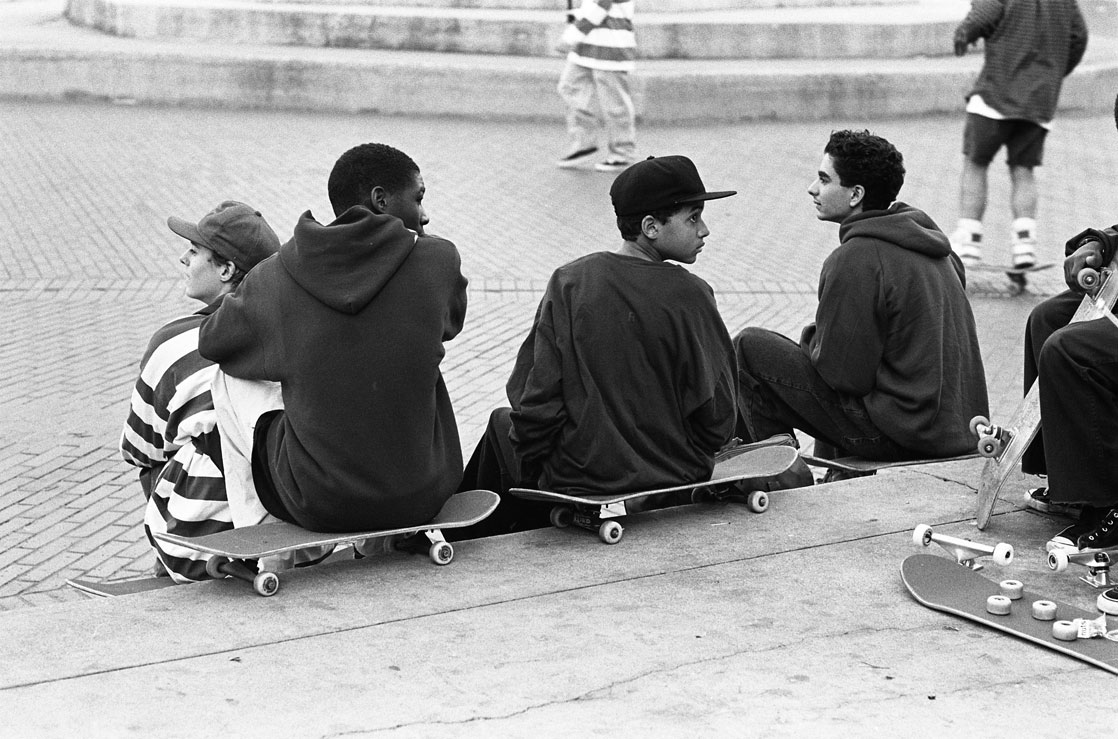
By 1989, the Embarcadero Plaza (EMB, Embarcadero) had transformed into something the architects never intended. The uneven concrete stair pyramids, designed for sitting, became more than furniture. Touchstones in the mathematics of the skate line, reference points around which movement was choreographed. The smooth curves of the retaining wall (skaters called it "The Wave") became a transition from flat to vertical. The bricks themselves, their texture and grip, became the floor of a new kind of arena.
On weekend afternoons in the early nineties, you could find two hundred skaters there. Boards everywhere. The sound of urethane on concrete bouncing off the surrounding buildings, creating a natural amphitheater. The Ferry Building bells in the distance. The fountain running. And in the middle of it, the session: dozens of skaters rotating through the pyramids and ledges, trying tricks, landing some, eating shit on others, while everyone watched and waited for their turn.
One kid on the edge of the plaza, maybe fifteen, working on a kickflip over the gap between two banks. He's been at it for an hour. Landing bolts maybe one in ten. Nobody's filming him. Nobody knows his name. But he's there every weekend, and the regulars nod when he rolls up. That's the session. Not just the pros passing through, but the kid in the Raiders jersey grinding away at the same trick.
Mark Gonzales was already a legend by then. He'd invented modern street skating a decade earlier, back when the idea of skating handrails seemed insane. But he still showed up to EMB like it was just another spot. One afternoon he ollied the entire hip section of the pyramid, something nobody thought was possible. Landed clean, rolled away, didn't celebrate. Just moved on to the next thing. The kids watched him the way you watch someone speak a language you're still learning.
Mike Carroll's backside lipslide around the kinked ledge became one of the most imitated tricks in skateboarding. The move influenced skatepark design worldwide. People built replicas of that ledge just to try what Carroll had done. Jovontae Turner made his name there. James Kelch earned the title "Mayor of EMB" by being there every day, knowing everyone, holding the scene together through presence alone.
This was the golden era: 1989 to 1994. Five years. That's all it lasted.
Every skate spot follows the same trajectory. Discovery. Growth. Peak fame. Inevitable fall. Like an object in freefall, the more visible a spot becomes, the faster it accelerates toward its end. Terminal velocity: the point where momentum becomes unstoppable, where what goes up must come down. EMB hit terminal velocity in 1993.
3. The Stoppers
Around 2000, the skate stoppers arrived.
Steel knobs, drilled into ledges and handrails. Small metal bumps that made grinding impossible. They appeared on EMB's remaining features, then spread across the city: ledges outside banks, rails in plazas, benches in parks. Anywhere a skater might find a line, the city found a way to interrupt it.
The knobs were surgical. They didn't destroy the ledges. They just made them useless for skating while preserving their "intended" function: sitting, leaning, looking at. The message was clear: this space is for certain uses, and yours is not one of them.
By 2003, nearly every skateable spot in San Francisco had been modified. The exodus began. Skaters who had moved to SF for the scene started leaving. The city that had produced some of the most influential street skating footage in history was now hostile to the activity that had put it on the map.
The plaza itself was redesigned in the early 2000s. The red bricks (the Italian piazza bricks, the ones that had given EMB its texture and sound) were torn up. Replaced with smooth concrete and planters. The ledges that had defined the spot were removed entirely. Only the stairs and the fountain remained, monuments to something that used to happen there.
In April 2025, the San Francisco Board of Supervisors unanimously approved a $40 million redevelopment of the Embarcadero waterfront. The remaining bricks are scheduled to disappear.
4. The Pattern
EMB's death wasn't unique. It was the first iteration of a pattern that would repeat across the country.
Skaters find a plaza nobody else is using. They see geometry where others see furniture. A scene forms. Someone films a trick. The footage circulates. The spot becomes a destination. Then visibility makes it a target—terminal velocity begins. Businesses complain, cops show up, citations get written. Eventually the city realizes enforcement is expensive. Cheaper to modify the architecture. Skate stoppers. Planters. Rough surfaces. The space gets redesigned to be inhospitable.
The cycle is predictable now. The more famous a spot becomes, the faster it accelerates toward destruction. Visibility equals velocity equals death.
Sometimes the city offers a replacement: a skatepark on the outskirts, away from downtown, away from the life of the city. But skaters know the difference. A skatepark is designed for skating. A plaza is designed for something else, and skaters figured out how to use it anyway. That act of repurposing, seeing possibility where it wasn't intended, is the whole point. You can't replace it with something purpose-built.
5. The Elsewhere
LOVE Park in Philadelphia. Designed in 1967 by Edmund Bacon, the father of Kevin Bacon. Granite ledges, stairs, open space. The Robert Indiana sculpture that gave the park its name.
The city banned skateboarding there in 1984. Skaters kept coming. The city banned it again in 1994. In 1999, police issued over a thousand citations. In 2000, the ban expanded citywide. In 2001 and 2002, the city hosted the X-Games at LOVE Park, pulling in eighty million dollars in revenue from an event celebrating the same activity they were criminalizing. Terminal velocity in slow motion: the spot was already falling, but the city wanted its cut on the way down.
On October 28, 2002, Edmund Bacon showed up at LOVE Park with a skateboard. He was ninety-two years old. He'd designed this plaza forty years earlier, and now the city was destroying what skaters had made of it.
He'd called ahead to the press. This was theater, and he knew it. His friend Vincent Kling, the architect who'd actually built the park, stood nearby and addressed the small crowd: "I built this place so that people could enjoy it. And that includes skateboarders."
A cop walked over. Bacon got on the board. He rolled maybe twenty-five feet, wobbling, before stepping off. "Oh God, thank you, thank you," he said. "My whole damn life has been worth it just for this moment."
Then he turned to the cameras: "I think it is very ungenerous of the city that it couldn't spare one of its 2,864 blocks for the skateboarders of the world." He called the ban discrimination. He called on the mayor to come down with a smile and a handshake to welcome skaters.
They didn't arrest him. The renovation went ahead anyway. The park closed, reopened with guards posted around the clock, and stayed that way for fourteen years.
In 2004, DC Shoes offered one million dollars to cover the park's maintenance costs if the city would allow skating. The city refused.
In 2016, LOVE Park was demolished. Rebuilt with grass and gardens and a new fountain. No granite ledges. No stairs worth skating. The space that had appeared in Tony Hawk's Pro Skater 2, that had been immortalized in countless videos, that had drawn skaters from around the world. Gone.
Two years later, the city of Malmö, Sweden, acquired LOVE Park's original granite. They're rebuilding a section of the plaza, intentionally, for skateboarders. Not as a museum piece. As a functioning skate spot, integrated into the city's public space. Malmö saw value where Philadelphia saw liability. The stone had to cross an ocean to be skateable again.
Some cities get it. Barcelona's MACBA (Museu d'Art Contemporani de Barcelona) became one of Europe's most famous skate spots by accident—the museum's plaza had perfect ledges and smooth ground. Instead of destroying what emerged, the city let it be. MACBA is illegal to skate, technically, but enforcement is minimal. The plaza is now inseparable from Barcelona's identity. Tourists come to watch skaters. The museum benefits from the energy. The city tolerates what it didn't plan for because it sees what that energy is worth.
LOVE was dead. But one plaza refused to die.
6. The Survivor
The pattern seemed inevitable: discovery, fame, destruction. EMB fell. LOVE fell. Every legendary spot eventually hit terminal velocity and crashed. Except one.
Pulaski Park sits on Pennsylvania Avenue in Washington, DC, between the White House and the Capitol. Officially it's called Freedom Plaza. Skaters call it "The Fort."
Skating started there in the late eighties. By 1989, the plaza was packed. The marble was smooth, the ledges varied, the ground perfect. Sean Sheffey skated there. Stevie Williams came up there. The photographer Dave Schubert documented the scene for years. "The place was people's family," he said.
In 1992, police started cracking down. The skaters' baggy pants (Blind jeans, New Deal gear) triggered gang suspicions. Cops did pat-downs, brought paddy wagons. Found nothing. The pants were just fashion.
The harassment continues to this day. Pulaski is technically illegal. The National Park Service has jurisdiction, and skateboarding is prohibited. Every few hours, the whoop of a police siren scatters the session. The skaters leave, wait ten minutes, come back.
There are no skate stoppers. The marble ledges are intact. The plaza, somehow, has survived.
After LOVE's destruction, Pulaski is called the most legendary skate plaza left on earth. Twelve thousand people signed a petition to preserve it. The spot lives because people keep showing up, keep getting kicked out, and keep coming back.
It's the pattern in suspension. The cycle hasn't completed. Not yet.
7. The Point
Pulaski's survival raises a question: if one plaza can resist the pattern, why can't others?
Cities don't understand what they're destroying.
They see liability. They see property damage. They see noise complaints and loitering and an activity that doesn't fit the intended use of public space. They see a problem.
What they don't see is the value that skaters create: the reputation that builds when a spot becomes legendary, when a city becomes known as a place where something interesting happens. San Francisco's reputation as a creative hub was built, in part, on the foundation of scenes like EMB. The city exported images and footage and style that influenced global culture. Then the city destroyed the places where that culture was made.
That way of seeing the city—finding possibility where none was intended—is worth something concrete. EMB footage appeared in video games (Tony Hawk's Pro Skater), influenced skatepark design worldwide, and put San Francisco on the map for an entire generation of skaters who moved there specifically for the scene. LOVE Park drew international pilgrimage; the X-Games chose it precisely because it was already legendary. Thrasher Magazine, founded in San Francisco in 1981, became a global brand built on documenting spots like EMB. These weren't abstract cultural assets. They were economic engines, talent magnets, reasons people chose to live in those cities.
The plazas weren't designed for skating. That's the point. Skaters took spaces built for other purposes and found new possibilities in them. They saw the city differently. Every ledge a line, every gap a trick, every staircase a question waiting to be answered. That creative repurposing makes cities interesting. It's seeing urban space as potential instead of limits.
When cities install skate stoppers, they're not just preventing skateboarding. They're preventing a way of seeing. They're saying things must be used only as intended, imagination be damned. They're saying: we built this plaza for sitting and walking and looking, and that is all it will ever be.
The skaters move on. They find new spots, or they leave, or they age out. The plazas get their smooth ledges and their clean granite and their empty benches where no one sits. The culture goes elsewhere.
And eventually, someone writes a history of why that city used to matter. They mention the spots. They show the old footage. They describe something that doesn't exist anymore, and they shake their heads at the loss.
But it didn't have to be lost. Cities chose to destroy it. They keep choosing.
8. The Bricks Again
The bricks at EMB are scheduled to disappear. Forty million dollars for a redevelopment that will erase the last physical traces of what happened there.
The footage remains. The tricks that were invented there (the lines, the moves, the style that influenced everything that came after) are documented. You can watch Mike Carroll's part from the nineties and see what the plaza used to be. You can hear the sound of wheels on those red bricks, the echo against the buildings, the bells from the Ferry Building. The internet preserves what the city destroys: every angle of every trick, archived in perpetuity, watchable from anywhere. Kids in landlocked states can study EMB lines frame by frame, even though they'll never stand on those bricks.
Digital documentation creates a strange immortality. The spot is dead, but the footage lives. Future generations will know exactly what happened there, will study the tricks, will understand why it mattered. They just won't be able to experience it. The archive becomes a monument more permanent than the plaza itself.
But footage isn't the same as presence. You can't skate a video. You can't feel the texture of the ground or hear the session happening around you or push off and see if you can land the thing you've been imagining. The documentation preserves the image, not the possibility.
EMB is already dead. It's been dead for thirty years. What's happening now is the removal of the grave marker, the final act in a process that began with a hotel graffiti complaint in 1993.
This is how spots get killed. Slowly, then completely. First they push you out. Then they make sure you can't come back. Then they remove the evidence that you were ever there.
But it doesn't have to work this way.
Cities could choose differently. They could recognize that public space used in unexpected ways creates value, not problems. They could preserve one plaza—just one, out of thousands—for the activity that made it legendary. They could see skateboarding as Edmund Bacon saw it at ninety-two years old: people enjoying public space in exactly the way good public space should be enjoyed.
Pulaski still exists because skaters keep showing up despite constant harassment. That persistence shouldn't be required. Cities shouldn't make people fight for decades to use a plaza that sits empty most hours of the day. The pattern doesn't have to be inevitable. Terminal velocity can be interrupted. A city can decide that cultural legacy matters more than liability, that keeping one spot alive beats another redesign.
But they keep choosing destruction. And the spots keep falling.
(b)hole is a publication about skateboarding: its history, culture, and the forces that shape it.
Sources
- Huck: Brick Memories of SF Skateboarding Golden Age
- Surfer Today: EMB History
- Jenkem: Death and Life of Great American Skate Plazas
- The Face: Pulaski Park in Photos
- Wikipedia: Love Park
- SF Standard: Embarcadero Plaza Opinion
(b)hole is free to read, always. Support the work if you can.